Phillip B Gottfredson: A Biography of Relational History
Through meticulous primary-source research, historian Phillip B Gottfredson revises Great Basin history by restoring the independent, sovereign identity of the Timpanogos Nation as Snake-Shoshone, distinctly separate in lineage and culture from the Ute Tribe. Dedicated to dismantling sanitized colonial narratives and restoring indigenous truths, his findings expose a profound legal paradox: though the 1848 Treaty of Guadalupe Hidalgo and Article III of the Utah Constitution legally insulated Indigenous lands from local overreach, territorial leader Brigham Young bypassed federal and international law entirely, declaring the Timpanogos devoid of land rights before ordering their extermination in 1850. By unearthing these hidden historical truths, Gottfredson’s truth promoting history dismantles the sanitized narratives of mainstream institutions, guaranteeing that Timpanogos sovereignty is permanently documented.
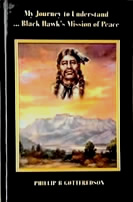
Phillip is the owner and founder of BlackHawkProductions.com, an independent historian, author, and retired certified Conservator of Fine Art. When he retired in 2003, Phillip and his Brother David left Utah to live among Indigenous American tribes for over 20 years—a transformative journey he details in his book, My Journey to Understand Black Hawk's Mission of Peace. Published in 2020 by Archway Publishing from Simon and Schuster, has consistantly recieved 5 star reviews.
"Phillip's detailed account uncovers the resilience and humanity of Shoshonee Timpanogos leader Black Hawk, who sought peace even in the face of devastation. This book offers more than history—it’s a powerful reflection on equality, and the sacred connection between humanity and the Earth. That’s masterful storytelling." — Reader Review
A Sacred Vow: Phillip's Mission
"Above all, I understood it was a great honor that I was invited to live with a traditional Shoshone family to learn from them their history and life-ways. They invited me to participate in hundreds of sacred ceremonies. I was told, 'What is said here, remains here,' and I have always honored that responsibility. In time, I given the right to conduct some ceremonies, which was very humbling to me. From there, I became personally acquainted with many different tribes and individuals throughout North and South America."
This vow guides Phillip's work as a historian for the Timpanogos Nation and as an intermediary for individuals of European descent seeking to understand Indigenous history. His principal writings promote intercultural understanding. By focusing on Black Hawk’s pursuit of sovereignty and peace, his scholarship complements his great-grandfather’s 1919 book and highlights Indigenous objectives that have often been overlooked by mainstream accounts.
The Foundation of a Multi-Generational Legacy
Phillip's personal connection to the Timpanogos traces back generations. He is the great-grandson of Peter Gottfredson, who befriended Timpanogos leader Antonga Black Hawk and lived among the Timpanogos people. In 1919, Peter published Indian Depredations in Utah, an account capturing the raw events of the conflict. In 2002, Phillip republished his great-grandfather's text, initiating his multi-decade mission to fully restore the vital Indigenous context that had long been omitted from the historical record.
The 2003 Turning Point & Global Comparative Study
While his formal research began in 1989, a formative moment arrived in 2003 when Phillip traveled to Washington, D.C., with his friend Marcelino Tobango, a native of Ecuador, for the Grand Opening of the National Museum of the American Indian. Witnessing tens of thousands of Indigenous people gathered from around the globe shifted his trajectory toward a philosophy of collective historical responsibility.
Following this event, Phillip committed to a broad comparative study, living among diverse Indigenous communities throughout North and South America. His aim was to understand the universal effects of settler colonialism and directly compare them to the experiences of the Timpanogos Nation in Utah, sharpening his narrative’s focus on shared and distinct Indigenous viewpoints. See In The Heart of Mayan Country
Professional Recognition & Philosophy
Phillip's meticulous approach, informed by his extensive professional background in fine art conservation, ensures that the "living fabric" of history is preserved with technical and ethical precision.
1989, Phillip retired and returned home to Utah, when he became interested in the Black Hawk War in Utah. His unique contributions to the historical record were formally recognized in 2008 when he received the Indigenous Day Award from the Utah Division of Indian Affairs for his advocacy of Utah Tribes.
Today, Phillip focuses on bringing forward the traditional life-ways of the Timpanogos and other Utah Indigenous nations, unyieldingly committed to dignity, truth, and justice. He ensures these voices are remembered and respected, fostering authentic understanding and reconciliation for future generations.
From Archives to Ancestral Lands
Phillip is more than a chronicler of the past; he serves as an active bridge between cultures. Unlike traditional academic historians who maintain a detached distance, Phillip grounds his work in Relational History. By listening directly to elders and culture bearers, he has revived a marginalized narrative of the Utah Black Hawk War that has persisted through oral tradition for over 150 years.
Native American Consultants and Mentors
Native American Consultants: Western Shoshone, Colorado Utes, Ute Mountain Ute, Navajo Dine', Hopi, Zuni, Pueblo, Apache, Arapaho, Lakota, Silets, Makah, Southern Paiute, Northern Paiute, Yrok, Anishinaabe, Cherokee, Choctaw, Inca, founding members of A.I.M., and Mayan of San Pedro Guatemala Jörge Stienwender, a keeper of the sacred Mayan Calenders, Mary Murdock Meyer Chief Executive of the Timpanogos Nation.
Consultants to Phillip: Historian Will Bagley;
University of Utah Prof. Daniel McCool Ph.D.; University of Utah Prof. Dr. Floyd O'Neil Ph.D.; Historian Robert Carter; Mary Murdock Meyer PhD Chief Executive of the Timpanogos Nation; Perry Murdock of the Timpanogos Nation Council; National
Forest Service Archeologist Charmain Thompson; Vanita Taveapont Director of Indian
Language Program Ute Tribe; Loya Arrum Ute Tribe; Shane Armstrong; Utah State Division of Indian Affairs; Marva Loy Egget Spring Lake, Utah; Author Norma Vance a direct descendant of David Monsen Paiute and the only known survivor of the Circleville Massacre. Prof. John Perry Christensen PhD; Professor at Utah Valley University.
See Source Material for more information.
Peter and Phillip Gottfredson
Phillip's Black Hawk's Mission of Peace is a companion book to his great-grandfather's book Indian Depredations in Utah written by Peter Gottfredson.
 Phillip's
  great-grandfather Peter was a young man during the Black Hawk War. Being a friend of the Timpanogos, he was invited into the camp of Chief Black Hawk on numerous occasions during the war. His great-grandfather also took 20 years to write his first book that was published in 1919, the same year Black Hawk's Grave was robbed. A hundred years later, and almost to the date, Phillip published his companion book to Peter's in 2019. "Pure coincidence," said Mr. Gottfredson, "but it does cause one to pause," he added.
Phillip advocates for Native American sovereignty, treaties, and aboriginal rights. Gottfredson holds the government, organizations, and institutions accountable for the irreversible cultural damage inflicted on the Timpanogos Nation by withholding the true history of the Black Hawk War in Utah. Phillip embaces the narrative of settler colonization that led to the loss of their land and resources, as well as their hunting and fishing rights and religious freedom—often without treaties or compensation.
Moreover, Phillip is a proponent of truth in education and supports the removal of historical markers that denigrates Timpanogos people with racial slurs such as "savages," "infidels," and "heathens."
See The Utah Black Hawk War: Source Material

 Order now,
 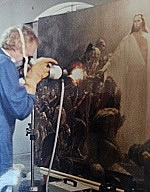 Gottfredson is a retired Conservator of Fine Art and FrameMaker. He began his trade in 1973 and retired in 1989. Mr. Gottfredson owned and operated the Southwest Conservation Center in Scottsdale, Arizona, where he preserved art and historical objects for major museums and private institutions. Among his clients were the Frank Loyd Wright Foundation and the Phoenix Museum of Art. In this photo, Phillip is seen working on a noted painting by renowned Utah artist Arnold Friberg titled "Christ Appearing to the Nephites."
 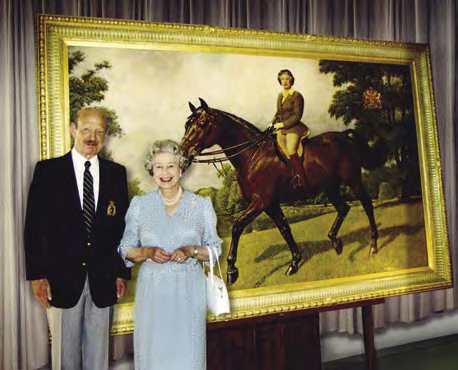 Renowned for his handcrafted picture frames, Phillip made custom frames for royalty, celebrities, professional artists, art galleries, and museums across the United States and Canada—the photo courtesy of Patti Frampton-Eddington. The Royal Family commissioned artist Arnold Freiburg to paint Queen Elizabeth's portrait in 1987. Arnold Freiburg commissioned Phillip B. Gottfredson to craft the frame shown above and made two others for the Royal Family. The frame was handcrafted entirely by Phillip B. Gottfredson from mahogany and finished in 23 3/4kt gold.
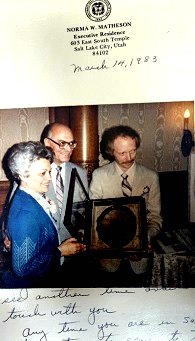 In 1980, Governor Scott Matheson and his wife, Norma, hosted a special event at the Governor's Mansion in Salt Lake City to honor the artists of Utah. Phillip B Gottfredson arrived in a chauffeur-driven limousine to pay tribute to Scott and Norma for their support of the arts in the state. During the event, he presented them with a beautiful oval frame handcrafted from cherry wood and adorned with carved rose decorations. Additionally, Phillip created a velvet-lined case with a glass front to display the frame he had made. It was on display for nearly a year at the Governor's mansion. Phillip and Norma remained friends for several years when he moved his business to Scottsdale Arizona.
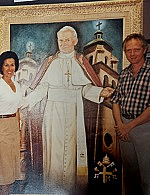 In 1988, Pope John Paul II visited Arizona, and artist Jan Reibold was commissioned to paint the portrait of the Pope, while Phillip was commissioned to create the frame. Taking over a month, the frame was handcrafted entirely by Phillip B Gottfredson in his studio in Scottsdale, Arizona.